Overview
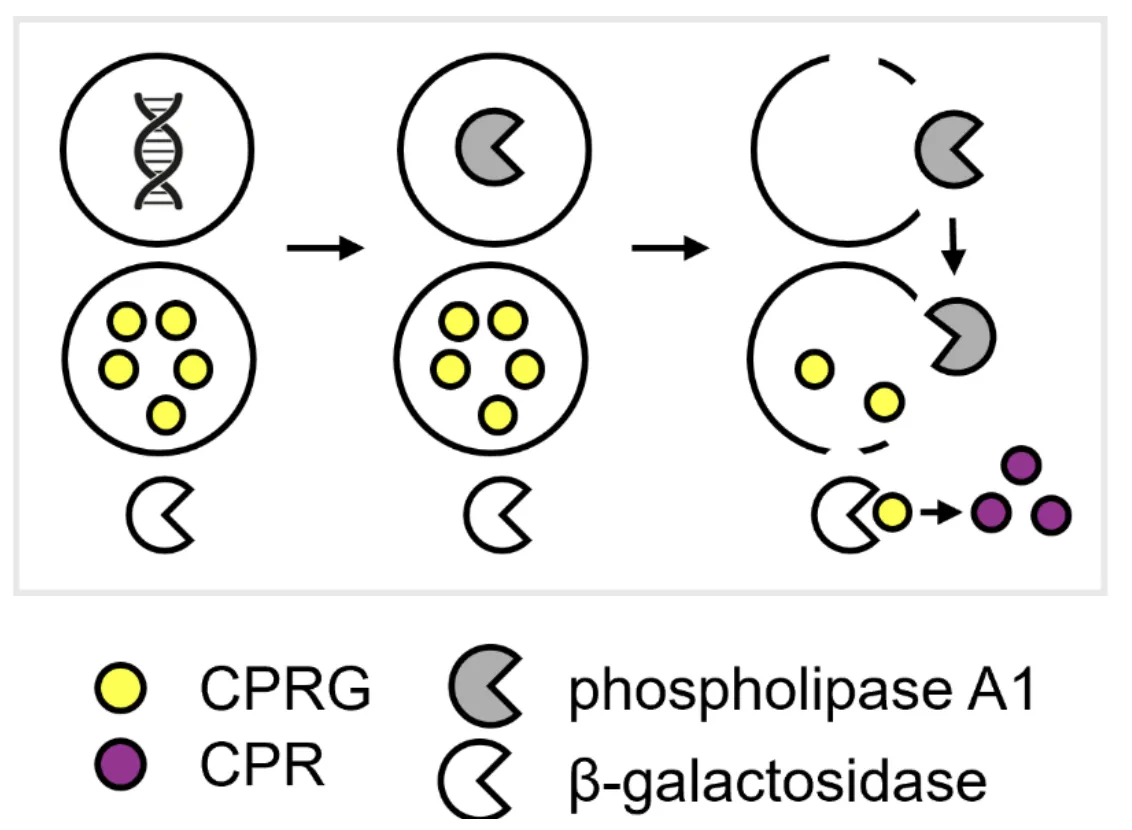
The pH Cascade turns an acidic outer solution into a visible color change with two liposome populations. Acidic pH makes the pH Sensing Cells express phospholipase A1 (PLA1). PLA1 lyses the neighboring substrate liposomes (Substrate LUV: CPRG or Substrate SUV: CPRG), which release chlorophenol red-β-D-galactopyranoside (CPRG) into the outer solution. β-galactosidase (LacZ) in the outer solution converts the yellow CPRG into the purple chlorophenol red (CPR). The cascade senses acidic pH, about 6.0 to 6.5.
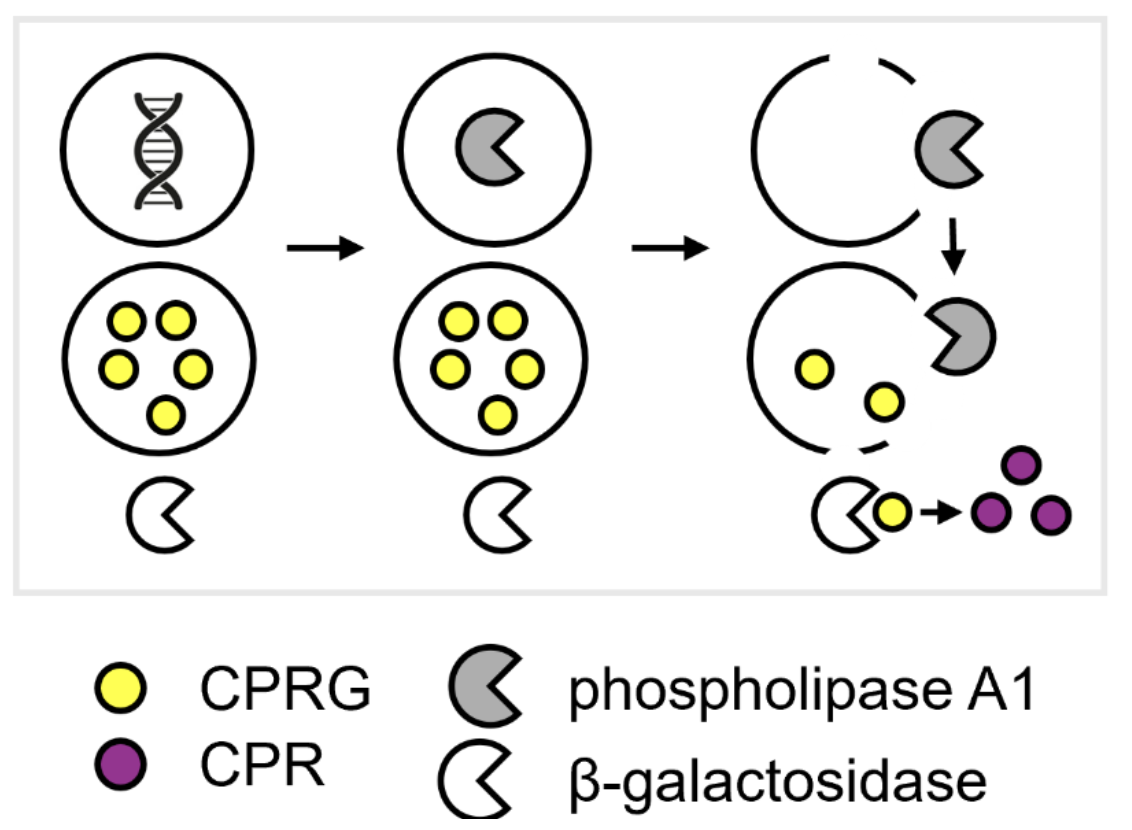
Schematic representation of the pH Cascade. A pH Sensing Cell with its DNA sits next to a substrate liposome (Substrate LUV: CPRG or Substrate SUV: CPRG), with β-galactosidase in the outer solution. The cell expresses PLA1, and PLA1 lyses the substrate liposome. The released CPRG is converted by β-galactosidase into CPR.
Reference Composition
DNA of the pH Cascade. All three constructs are in the pH Sensing Cell.
| Name | Length | Supply | File |
|---|---|---|---|
pT7-toehold9-PLA1-linear | 1203 bp | Linear DNA template, added to the cell cytosol at 2 nM | pT7 |
pH-responsive-ssDNA-2 | 49 nt | Single-stranded oligo, annealed with the trigger strand | pH |
trigger-ssDNA-3 | 36 nt | Single-stranded oligo, annealed with the pH-responsive strand | trigger-ssDNA-3.gb |
β-galactosidase is added as purified enzyme and has no DNA construct.
The pH Sensing Cell is 50 mL/L of a 60 µL assay.
Inner solution of the pH Sensing Cell.
| Component | Input concentration | Final concentration | Volume for one preparation (µL) |
|---|---|---|---|
| SMix | 3.33× | 1× | 6 |
| PMix | 15 mg/mL | 1.80 mg/mL | 2.4 |
| Ribosomes | 10 µM | 1.8 µM | 3.6 |
| tRNA | 35 mg/mL | 3.5 mg/mL | 2 |
pT7-toehold9-PLA1-linear DNA template | 80 nM | 2 nM | 0.5 |
| pH-responsive : trigger ssDNA duplex (3:1), annealed | 25 µM, as the trigger strand | 4.625 µM | 3.7 |
| Optiprep | 1000 mL/L | 45 mL/L | 0.9 |
| RNase inhibitor | 40 000 U/mL | 1000 U/mL | 0.5 |
| Cy5 (sulfo-Cyanine5 carboxylic acid) | 100 µM | 2 µM | 0.4 |
| Total volume (µL) | 20 |
Membrane of the pH Sensing Cell. Volumes are for the lipid stocks that make 2.5 µmol of total lipid.
| Component | Target (mmol/mol) | Molecular Weight (g/mol) | Stock concentration (mg/mL) | Volume to add (µL) |
|---|---|---|---|---|
| POPC | 899.1 | 760.076 | 25 | 68.34 |
| Cholesterol | 99.9 | 386.654 | 50 | 1.93 |
| Liss-Rhod PE | 1 | 1301.71 | 1 | 3.25 |
The Substrate LUV: CPRG is 35 mL/L of a 60 µL solution assay and 50 mL/L of a 60 µL gel assay.
Inner solution of Substrate LUV: CPRG.
| Component | Stock concentration | Final concentration | Volume for one preparation (µL) |
|---|---|---|---|
| CPRG | 30 mg/mL | 14.25 mg/mL | 237.5 |
| Optiprep | 1000 mL/L | 100 mL/L | 50 |
| Tris1M-HEPES1.15M buffer stock | 2520 mOsm | 1071 mOsm | 212.5 |
| Total volume (µL) | 500 |
Membrane of Substrate LUV: CPRG. Volumes are for the lipid stocks that make 2 µmol of total lipid.
| Component | Target (mmol/mol) | Molecular Weight (g/mol) | Stock concentration (mg/mL) | Volume to add (µL) |
|---|---|---|---|---|
| POPC | 899.1 | 760.076 | 25 | 54.67 |
| Cholesterol | 99.9 | 386.654 | 50 | 1.55 |
| Liss-Rhod PE | 1 | 1301.71 | 1 | 2.60 |
The Substrate SUV: CPRG is used in place of the LUV. Its membrane is the same as the LUV’s.
Inner solution of Substrate SUV: CPRG.
| Component | Final concentration | Volume for one preparation (µL) |
|---|---|---|
| CPRG | not documented | not documented |
| Other components | not documented | not documented |
| Total volume (µL) | 1000 |
Outer solution of the pH Cascade, as a fraction of the assay volume. The pH 7.6 arm takes the Tris1M-HEPES1.15M buffer stock, and the pH 6.3 arm takes the buffer mix for pH 6.3.
| Component | Fraction (mL/L) |
|---|---|
| Energy solution (2×) | 500 |
| Ultrapure water | 260 |
| Tris1M-HEPES1.15M buffer stock, or buffer mix for pH 6.3 | 120 |
| pH Sensing Cells and substrate liposomes in suspension buffer | 120 |
| Total | 1000 |
In a solution assay the 120 mL/L is 3 µL of cells (50 mL/L), 2.1 µL of substrate liposomes (35 mL/L) and 2.1 µL of suspension buffer (35 mL/L) in 60 µL. In a gel assay it is 3 µL of cells (50 mL/L), 3 µL of substrate liposomes (50 mL/L) and 1.2 µL of suspension buffer (20 mL/L).
Buffer mix for pH 6.3. It replaces the Tris1M-HEPES1.15M buffer stock in the acidic arm.
| Component | Fraction (mL/L) | Volume (µL) |
|---|---|---|
| Tris1M-HEPES1.15M buffer stock | 388.9 | 466.67 |
| 2 M HEPES stock | 480.2 | 576.19 |
| 37 % HCl | 66.7 | 80 |
| Ultrapure water | 64.3 | 77.14 |
| Total volume (µL) | 1000 | 1200 |
Energy solution (2×), a sub-mix of ten components made up to 4000 µL, adapted from the PURE formulation (Shimizu et al., 2001) and the OnePot PURE method (Lavickova and Maerkl, 2019). The final concentration is the concentration in the assay.
| Component | Stock concentration | Volume (µL) | Final concentration |
|---|---|---|---|
| Spermidine | 1 M | 12 | 1.5 mM |
| Creatine phosphate | 1 M | 200 | 25 mM |
| Magnesium acetate tetrahydrate | 1 M | 144 | 18 mM |
| L-Glutamic acid potassium salt monohydrate | 2 M | 1120 | 280 mM |
| Folinic acid calcium salt hydrate | 332 mM | 9.2 | 0.3818 mM |
| ATP | 100 mM | 300 | 3.75 mM |
| GTP | 100 mM | 200 | 2.5 mM |
| CTP | 100 mM | 100 | 1.25 mM |
| UTP | 100 mM | 100 | 1.25 mM |
| Amino acid mix (RTS Amino Acid Sampler) | 6 mM | 400 | 0.3 mM |
| Ultrapure water | 1414.8 | ||
| Total volume (µL) | 4000 |
Enzyme added for the readout. β-galactosidase is added as a 3× solution in the basic buffer at pH 9.9, and dilutes the assay volume from 60 µL to 90 µL.
| Component | Stock concentration | 3× concentration | Final concentration |
|---|---|---|---|
| β-galactosidase | 1000 U/mL | 3.6 U/mL | 1.2 U/mL |
Expected Behavior
Cells
The pH Cascade is expected to turn from yellow to purple in solution in the pH 6.3 arm, and to stay yellow in the pH 7.6 arm, when β-galactosidase is added at the readout in the basic buffer (pH 9.9), which raises the pH so that the enzyme can act. The color was visible by eye after 5.5 h at 37 °C with 1.2 U/mL β-galactosidase. A run with 2 U/mL was read after 2 h. Gramicidin A is not part of the composition: it caused a portion of the CPRG-loaded liposomes to rupture prematurely, which gave nonspecific color, and PLA1 expression driven by proton diffusion into a subset of liposomes with relatively permeable membranes appeared to be sufficient to start lysis. Data are in the Colorimetric pH Sensor, read by Colorimetric Readout.
Gels
The pH Cascade with Substrate SUV: CPRG in 3.5 mg/mL low-gelling agarose is expected to show the same color pattern as in solution. In 7 mg/mL low-gelling agarose with 2 U/mL β-galactosidase, color developed without PLA1 (see Substrate LUV: CPRG). Data are in the Colorimetric pH Sensor, read by Colorimetric Readout.
Requirements
Requires a control that separates sensing-driven color from CPRG leakage. A control without pH Sensing Cells shows leakage that happens without PLA1 (see Substrate LUV: CPRG).
Requires that gramicidin A is not added (see Expected Behavior).
Implementations
Processes
Anneal pH Trigger Duplex makes the duplex of the pH Sensing Cell.
Encapsulation: Freeze-Thaw makes the substrate liposomes, as LUVs or SUVs.
Protocol: Inverted Emulsion makes the pH Sensing Cells.
Embedding: Thermal Setting places both populations in a gel.
Colorimetric Readout develops and reads the color.
Materials
| Name | Category | Product | Manufacturer | Part # | Price | Storage | Link |
|---|---|---|---|---|---|---|---|
| Spermidine | Chemical | Spermidine, ≥99% (GC) | Sigma-Aldrich | S2626-5G | $176 | -25 °C to -15 °C | link |
| Creatine phosphate | Chemical | Creatine phosphate | Millipore Sigma | 10621714001 | link | ||
| Magnesium acetate tetrahydrate | Chemical | Magnesium acetate tetrahydrate | Millipore Sigma | M5661 | -85 °C to -15 °C | link | |
| Potassium glutamate | Chemical | L-Glutamic acid potassium salt monohydrate | Sigma-Aldrich | G1501-100G | $74.80 | 4 °C to 30 °C | link |
| Folinic acid | Chemical | Folinic acid calcium salt hydrate | Sigma-Aldrich | F7878-100MG | $108 | 4 °C to 30 °C | link |
| ATP | Chemical | ATP | Millipore Sigma | A6419-1G or 5G | -85 °C to -15 °C | link | |
| GTP | Chemical | GTP | Millipore Sigma | G8877-250MG | -85 °C to -15 °C | link | |
| CTP | Chemical | CTP | Millipore Sigma | C1506-250MG | -85 °C to -15 °C | link | |
| UTP | Chemical | UTP | Millipore Sigma | U6750-1G or 500MG | -85 °C to -15 °C | link | |
| Amino acid mix | Reagent | RTS Amino Acid Sampler | Biotechrabbit | BR1401801 | €395.00 | -85 °C to -15 °C | link |
| HEPES | Salts | HEPES, Crystalline Powder, ≥99.5% (titration), Poly bottle | Sigma-Aldrich | H3375-500G | $431 | 4 °C to 30 °C | link |
| Hydrochloric acid | Chemical | Hydrochloric acid, ACS reagent, 37% | Millipore Sigma | 320331-500ML | $106.00 | 4 °C to 30 °C | link |
| β-galactosidase | Reagent | β-Galactosidase from Escherichia coli, Grade VIII, lyophilized powder, ≥500 units/mg protein | Sigma-Aldrich | G5635 | −20 °C | link |
Constituent Modules
pH Sensing Cell — population that expresses PLA1 at acidic pH
Color Change — lyses the substrate liposomes when PLA1 is present and reports the released CPRG as a color, through Substrate LUV: CPRG or Substrate SUV: CPRG and Reporter: LacZ Enzyme
Credits
Developed by Sung-Won Hwang, Samuel Chen and Allen P. Liu (University of Michigan).
Supported by
DevNotes that support this specification include:
- Shimizu, Y., Inoue, A., Tomari, Y., Suzuki, T., Yokogawa, T., Nishikawa, K., & Ueda, T. (2001). Cell-free translation reconstituted with purified components. Nature Biotechnology, 19(8), 751–755. 10.1038/90802
- Lavickova, B., & Maerkl, S. J. (2019). A Simple, Robust, and Low-Cost Method To Produce the PURE Cell-Free System. ACS Synthetic Biology, 8(2), 455–462. 10.1021/acssynbio.8b00427