Overview
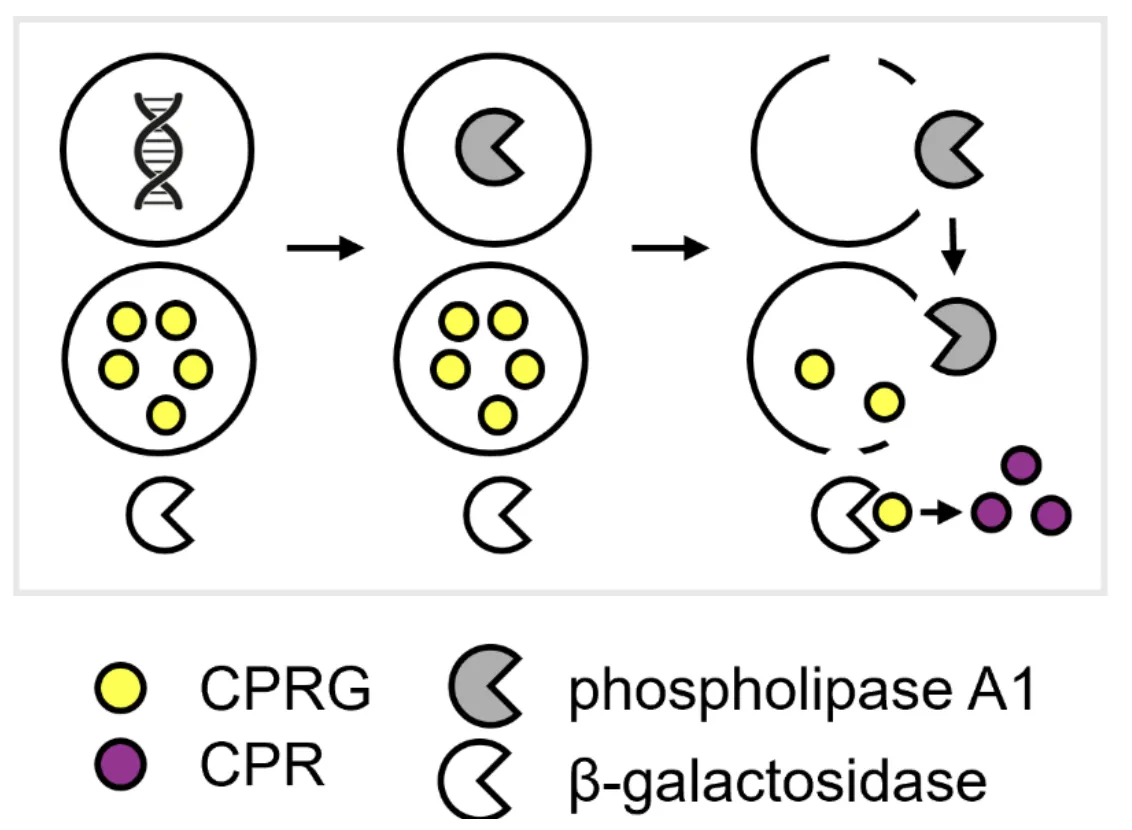
Colorimetric Readout develops and reads the color of a system that holds a color reporter. The reporter used here is β-galactosidase (LacZ). It converts the yellow substrate chlorophenol red-β-D-galactopyranoside (CPRG) into the purple chlorophenol red (CPR). The enzyme is added to a sample of gel or solution as a 3× solution in a basic buffer at pH 9.9, to a final concentration of 1.2 U/mL. The basic buffer raises the pH of the sample so that β-galactosidase can act. The sample is then incubated at 37 °C, and the color is read by eye and recorded by photograph, so the result is a color and not a number. The system documented here is the pH Cascade, where lysis of substrate liposomes (Substrate LUV: CPRG or Substrate SUV: CPRG) releases CPRG into the outer solution. The enzyme is the LacZ Enzyme Reporter.
Materials and Equipment
β-galactosidase at 1000 U/mL, 1 M Tris base, and 37 % HCl are required. The sample is a 60 µL gel or a 60 µL solution. The β-galactosidase is from Escherichia coli (Sigma-Aldrich G5635, Grade VIII, lyophilized powder, ≥500 units/mg protein).
Protocol
Prepare the Basic Buffer
Mix 1 mL of 1 M Tris base with 2.5 µL of 37 % HCl. The buffer has a pH of 9.9 and a measured osmolarity of 1165 mOsm/kg. Its job is to raise the pH of the sample when it is added.
Prepare the 3× β-Galactosidase Solution
Dilute the 1000 U/mL β-galactosidase stock to 3.6 U/mL in the pH 9.9 basic buffer.
Develop the Color
Add 30 µL of the 3× solution to 60 µL of gel or solution. The total volume is 90 µL, and the final concentration is 1.2 U/mL β-galactosidase.
Incubate at 37 °C. The reported runs read the color after 2 h (at 2 U/mL) and after 5.5 h (at 1.2 U/mL).
Read the color by eye and photograph the wells. CPRG is yellow, and CPR is purple.
Credits
Developed by Sung-Won Hwang, Samuel Chen and Allen P. Liu (University of Michigan).
Supported by
DevNotes that support this page include: