Overview
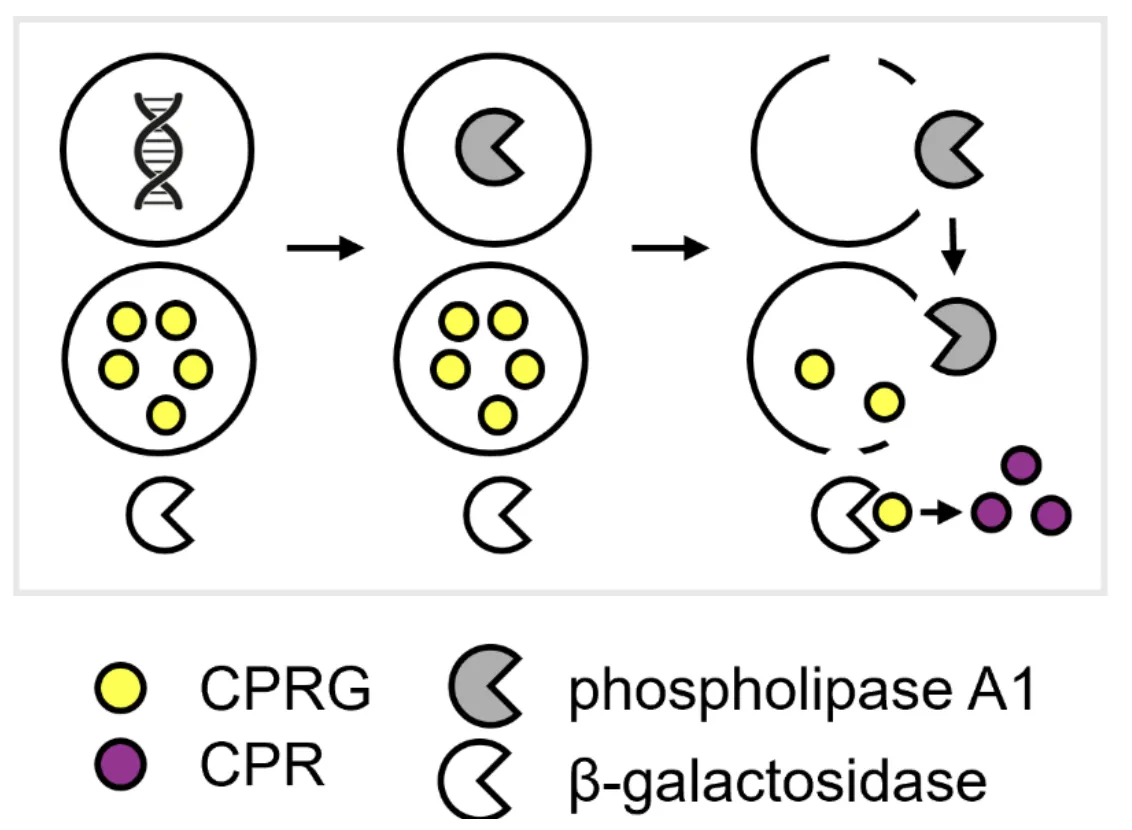
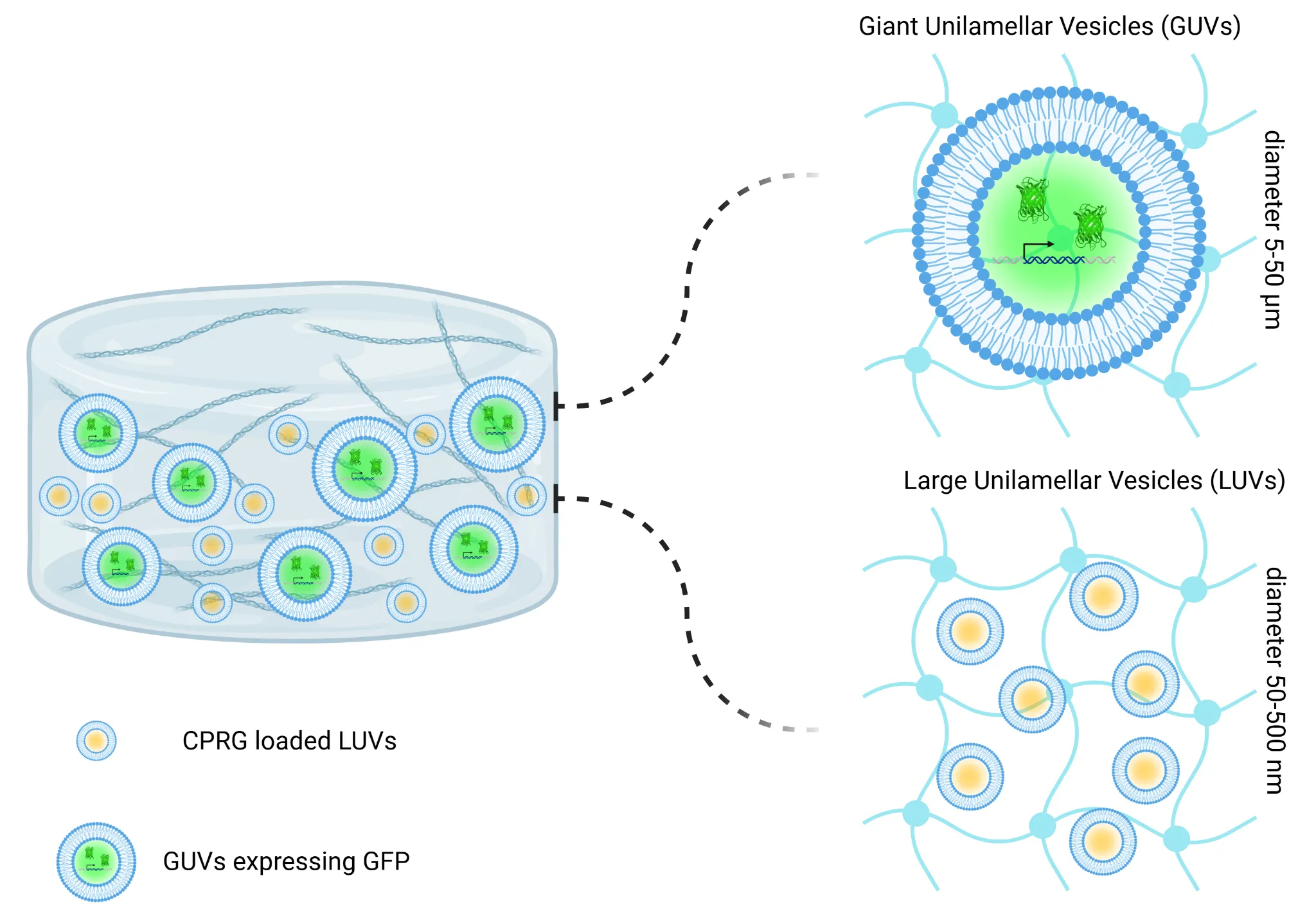
Substrate LUV: CPRG encapsulates the chromogenic substrate chlorophenol red-β-D-galactopyranoside (CPRG) in large unilamellar vesicles (LUVs) with a POPC/cholesterol membrane. It is a substrate population of the pH Cascade. Intact LUVs keep CPRG inside. A lytic enzyme such as phospholipase A1 (PLA1) disrupts the membrane, and CPRG is released into the outer solution. There, β-galactosidase converts the yellow CPRG into the purple chlorophenol red (CPR). The LUVs are made by Encapsulation: Freeze-Thaw without extrusion. Substrate SUV: CPRG is the extruded alternative.
Reference Composition
Inner solution of Substrate LUV: CPRG.
| Component | Stock concentration | Final concentration | Volume for one preparation (µL) |
|---|---|---|---|
| CPRG | 30 mg/mL | 14.25 mg/mL | 237.5 |
| Optiprep | 1000 mL/L | 100 mL/L | 50 |
| Tris1M-HEPES1.15M buffer stock | 2520 mOsm | 1071 mOsm | 212.5 |
| Total volume (µL) | 500 |
The Tris1M-HEPES1.15M buffer stock is 1 M Tris and 1.15 M HEPES at pH 8, about 2520 mOsm/kg, measured. The 1071 mOsm is the contribution of the buffer stock to the inner solution.
Membrane. Volumes are for the lipid stocks that make 2 µmol of total lipid.
| Component | Target (mmol/mol) | Molecular Weight (g/mol) | Stock concentration (mg/mL) | Volume to add (µL) |
|---|---|---|---|---|
| POPC | 899.1 | 760.076 | 25 | 54.67 |
| Cholesterol | 99.9 | 386.654 | 50 | 1.55 |
| Liss-Rhod PE | 1 | 1301.71 | 1 | 2.60 |
Suspension buffer, the outer solution after preparation. Its pH is 8, and its osmolarity is 1170 mOsm/kg to 1180 mOsm/kg.
| Component | Concentration |
|---|---|
| Tris1M-HEPES1.15M buffer stock | 466.7 mL/L |
The Tris1M-HEPES1.15M buffer stock is 1 M Tris and 1.15 M HEPES at pH 8, about 2520 mOsm/kg, measured.
Expected Behavior
Solution
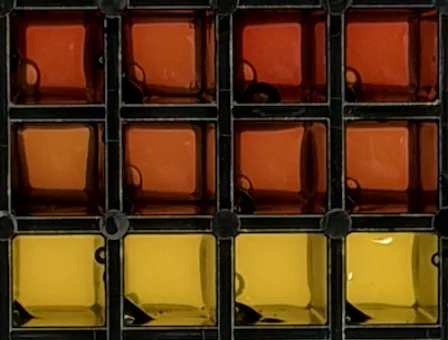
Substrate LUV: CPRG is expected to keep CPRG inside at neutral pH and release it when a lytic enzyme such as PLA1 disrupts the membrane. In solution, pH Sensing Cells with Substrate LUV: CPRG gave a visible color change at pH 6.3 and stayed yellow at pH 7.6. Data are in the Colorimetric pH Sensor, read by Colorimetric Readout.
Gels
Substrate LUV: CPRG is expected to keep CPRG inside until a lytic enzyme such as PLA1 disrupts the membrane. In 7 mg/mL low-gelling agarose it does not: LUVs develop color without PLA1, which points to CPRG leakage. The control without pH Sensing Cells turned pink after β-galactosidase was added. Data are in the Colorimetric pH Sensor, read by Colorimetric Readout.
Requirements
Requires a membrane-lytic activity to release CPRG (e.g. the pH Sensing Cell, which expresses PLA1).
Requires β-galactosidase in the outer solution to convert released CPRG (e.g. Reporter: LacZ Enzyme).
Implementations
Processes
Encapsulation: Freeze-Thaw makes the LUVs, with the lipid film hydrated in 0.5 mL (4 mM total lipid).
Embedding: Thermal Setting places them in a gel.
Colorimetric Readout develops the color of released CPRG.
Materials
| Name | Category | Product | Manufacturer | Part # | Price | Storage | Link |
|---|---|---|---|---|---|---|---|
| CPRG | Reagent | Chlorophenol Red-β-D-galactopyranoside | Roche | 10884308001 | $160.00 | -20 °C in water at 20 mg/mL | link |
| Optiprep | Reagent | OptiPrep™ | STEMCELL Technologies | 07820 | $289.00 | RT | link |
| HEPES | Salts | HEPES, Crystalline Powder, ≥99.5% (titration), Poly bottle | Sigma-Aldrich | H3375-500G | $431 | 4 °C to 30 °C | link |
| POPC | Lipid | 16:0-18:1 PC 25 mg/mL | Avanti Lipids | A80557 | $435.00 | -20 °C | link |
| Cholesterol | Lipid | Cholesterol (plant) | Avanti Research | A80100 | $261.00 | -20 °C | link |
| Liss-Rhod PE | Lipid | 18:0 Liss Rhod PE 1 mg/mL | Avanti Lipids | A81179 | $273.47 | -20 °C | link |
Supported by
DevNotes that support this specification include: