Overview
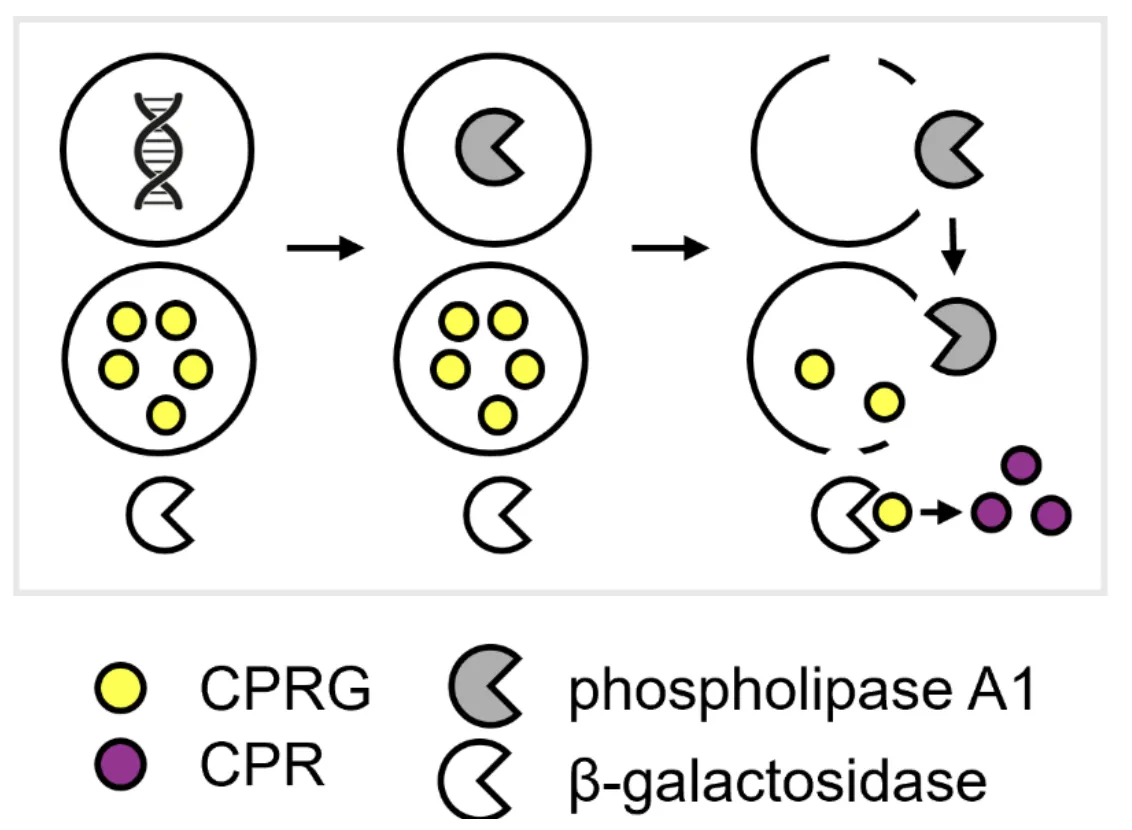
Protocol: Inverted Emulsion is a second protocol for Encapsulation: Phase Transfer. It encapsulates an aqueous inner solution, such as a Cytosol with DNA, inside giant unilamellar vesicles (GUVs). Sonication and heat disperse the lipids in mineral oil. This lipid-in-oil dispersion rests on the outer solution for 10 min to 20 min to form the oil–water interface. The inner solution is emulsified in the dispersion by pipetting for 3 min. The droplets are layered on the interface and centrifuged through it at 2500 g and 15 °C. Use this protocol for the pH Sensing Cell. The Module specification gives the inner solution, the membrane and the outer solution.
Hazardous Materials
Chloroform - Irritant, possible carcinogen. Work in a fume hood and use gloves.
Lipid stocks for the lipid-in-oil dispersion at the 3 mL working scale (1.5 µmol of total lipid, 899.1 / 99.9 / 1 mmol/mol). Scale all three volumes together for another volume of oil.
| Component | Stock concentration (mg/mL) | Volume to add (µL) | Target (mmol/mol) |
|---|---|---|---|
| POPC | 25 | 41.0 | 899.1 |
| Cholesterol | 50 | 1.16 | 99.9 |
| Liss-Rhod PE | 1 | 1.95 | 1 |
Materials and Equipment
Materials for the lipid-in-oil dispersion.
| Name | Category | Product | Manufacturer | Part # | Price | Storage | Link |
|---|---|---|---|---|---|---|---|
| POPC | Lipid | 16:0-18:1 PC 25 mg/mL | Avanti Lipids | A80557 | $435.00 | -20 °C | link |
| Cholesterol | Lipid | Cholesterol (plant) | Avanti Research | A80100 | $261.00 | -20 °C | link |
| Liss-Rhod PE | Lipid | 18:0 Liss Rhod PE 1 mg/mL | Avanti Lipids | A81179 | $273.47 | -20 °C | link |
| Mineral oil, light | Chemical | Mineral oil, BioReagent, for molecular biology, light oil | Millipore Sigma | M5904-500ML | $78.70 | RT | link |
A 20 mL glass vial, argon gas, a vacuum desiccator, a bath sonicator, a 60 °C heat block, 1.5 mL tubes, 0.2 mL PCR tubes, and a refrigerated centrifuge are also required. The inner solution and the outer solution come from the Module specification.
Protocol
Prepare the Lipid-in-Oil Dispersion
Combine the three lipid stocks in a 20 mL glass vial. Use the volumes in the lipid table in the Overview. All three stocks are in chloroform.
Remove the chloroform under a gentle argon flow.
Dry the vial in a vacuum desiccator for 30 min.
Resuspend the lipids in 3 mL of mineral oil. The result is 0.5 mM total lipid in oil.
Seal the vial and disperse the lipids. Do four operations in this order:
Bath sonicate for 20 min.
Incubate at 60 °C for 1 h.
Vortex for 2 min.
Bath sonicate for 20 min.
Form the Oil–Water Interface
Layer 300 µL of the lipid-in-oil dispersion gently over 400 µL of outer solution in a 1.5 mL tube.
Incubate the tube at room temperature for 10 min to 20 min.
Form the Emulsion
Prepare the inner solution in a separate 1.5 mL tube. Do this during the incubation. The pH Sensing Cell uses 20 µL.
Add 600 µL of the lipid-in-oil dispersion to the inner solution.
Pipette up and down thoroughly for 3 min. This forms water-in-oil monolayer emulsion droplets.
Transfer and Collect the GUVs
Add the droplets on top of the oil–water interface.
Centrifuge at 2500 g for 15 min at 15 °C.
Remove the oil phase carefully with a pipette.
Collect the GUVs into a 0.2 mL PCR tube with a fresh pipette tip.
Resuspend the GUVs gently.
Supported by
DevNotes that support this page include: