Overview
The LacI-IPTG Detector Module is a set of two genetic constructs that encode IPTG-inducible gene expression. pT7-lacI encodes the lac operon repressor protein LacI. pT7-lacO-plamGFP is a GFP reporter construct under a T7 promoter controlled by a lacO operator site. In the absence of LacI, pT7-lacO-plamGFP expresses plamGFP. Adding LacI — either as a purified protein or by expressing it off of pT7-lacI — binds the lacO operator site and represses transcription by sterically occluding the promoter from its polymerase. Isopropyl β-d-1-thiogalactopyranoside (IPTG) recovers expression by allosterically binding LacI and causing it to release lacO. The pT7-lacO promoter is also a MoClo Level 0 ‘P’ part and may be assembled into a Level 1 transcription unit with other MoClo-compatible genes.
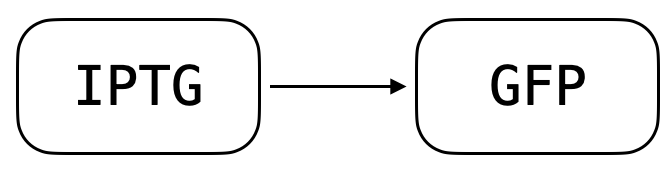
Schematic of the LacI-IPTG detector module. IPTG relieves LacI repression of pT7-lacO-plamGFP, recovering GFP expression.
Reference Composition
| Name | Length (bp) | File |
|---|---|---|
pT7-lacI | 2877 | pOpen-lacI.gb |
pT7-lacO-plamGFP | 2958 | pOpen-pT7-lacO.gb |
Assemble pT7-lacO-plamGFP into a standard PURE reaction. Add purified LacI protein to a final concentration of 500 nM to 1000 nM, or include the pT7-lacI DNA construct. Add IPTG inducer at 500 nM to 2000 nM for effective induction.
| Component | Master Mix (µL) |
|---|---|
| PURExpress Solution A | 4 |
| PURExpress Solution B | 3 |
| RNase Inhibitor | 0.5 |
pT7-lacO-plamGFP (10 nM) | 0.5 |
| LacI (10 µM) | 0.5 |
| Master Mix Total | 9 |
| Component | Per Reaction (µL) |
|---|---|
| Master Mix | 9 |
| IPTG (10 µM) | 1 |
| Total | 10 |
Expected Behavior
Cytosols
We’ve validated the LacI-IPTG module in NEB PURExpress reactions by adding purified LacI repressor protein (MedChemExpress HY-P70247) at the final concentrations indicated, with pT7-lacO-plamGFP plasmid DNA at 5 nM to 10 nM.
We observe repression across a wide range of LacI concentrations (15.63 nM –1000 nM), with 1000 nM showing strong repression and suitable dynamic range for use in an inducible system. We saw a small increase in expression around 62.5 nM repressor; we saw a similar effect in TetR data and may reflect a shared mechanism (e.g., preserving PURE translational capacity under moderate transcriptional repression). The 250 nM datapoint is likely a technical failure. IPTG induction is effective across 500 nM to 2000 nM, consistent with concentrations used in cellular and cell-free systems (Garamella et al., 2016). All induced samples show expression at or above the unrepressed positive control, a behavior that we’ve replicated across multiple experiments and is worth of further investigation.
In vitro repression with LacI
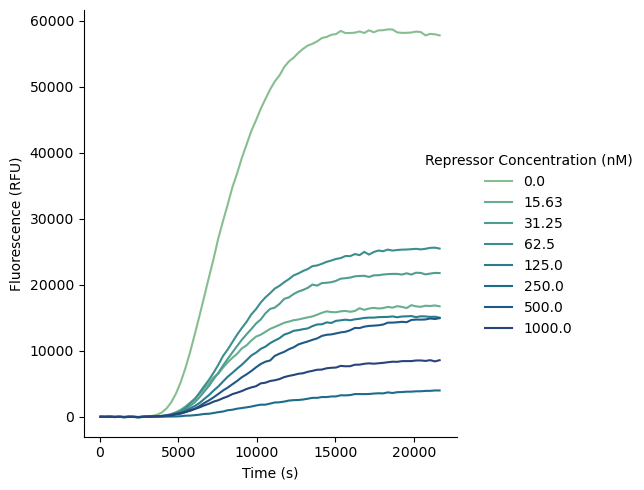
Repression kinetics of pT7-lacO-plamGFP by LacI at varying repressor concentrations. pT7-lacO-plamGFP plasmid DNA at 5 nM.
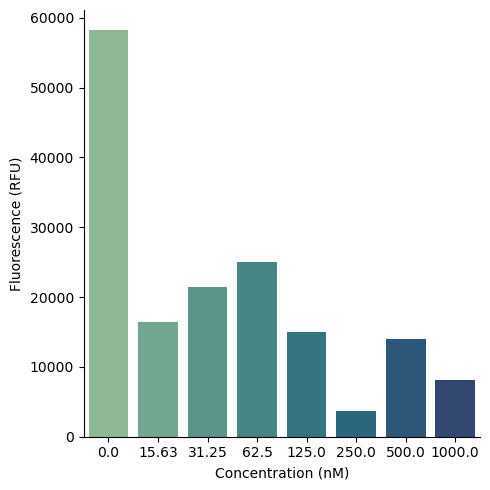
Repression of pT7-lacO-plamGFP by LacI at steady state. pT7-lacO-plamGFP plasmid DNA at 10 nM.
In vitro induction with IPTG
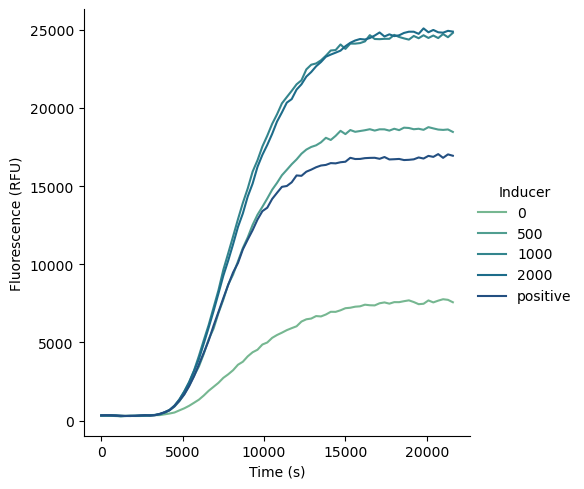
Induction kinetics of pT7-lacO-plamGFP by IPTG. LacI repressor protein present at 500 nM. Positive control is pT7-lacO-plamGFP without LacI repressor.
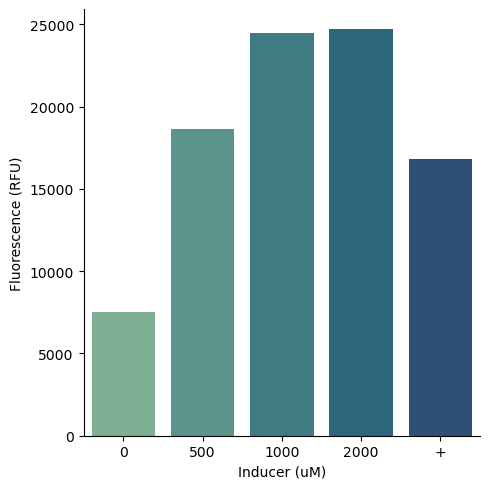
Induction of pT7-lacO-plamGFP by IPTG at steady state. LacI repressor protein present at 500 nM. Positive control is pT7-lacO-plamGFP without LacI repressor.
Cells
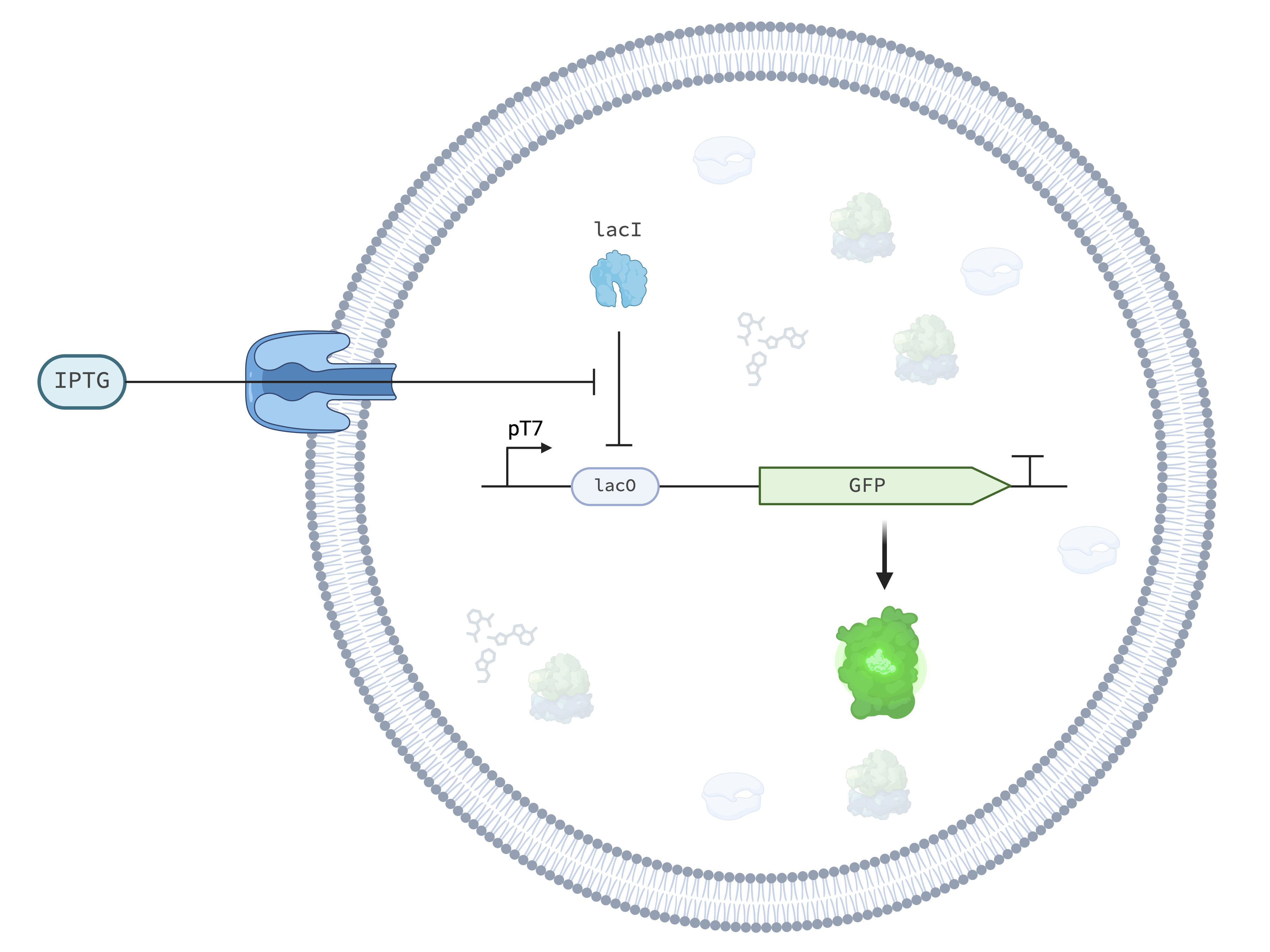
Schematic representation of LacI-IPTG Detector module in the Base Cell.
Cell performance data is not yet available for this module.
Requirements
Requires pT7 transcription and translation (e.g. Base Cytosol). If used in a synthetic cell, requires IPTG transport across membrane (e.g., Cx43 pore).
Credits
Developed by b.next.
- Garamella, J., Marshall, R., Rustad, M., & Noireaux, V. (2016). The All E. coli TX-TL Toolbox 2.0: A Platform for Cell-Free Synthetic Biology. ACS Synthetic Biology, 5(4), 344–355. 10.1021/acssynbio.5b00296