Overview
The PPK energy Module generates ATP and GTP from AMP and GDP, respectively, using inorganic polyphosphate (100mer) as a phosphate donor. This module complements the default energy module in Nucleus Cytosol.
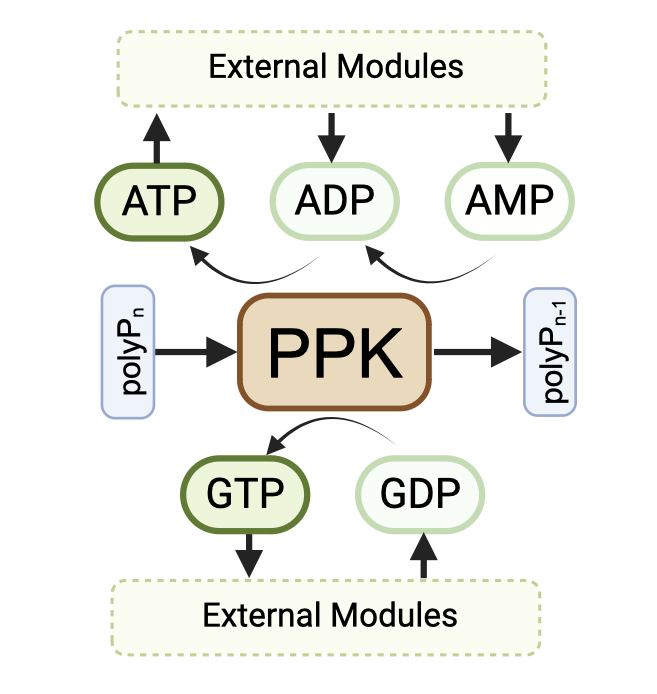
PPK uses inorganic polyphosphate (polyPₙ) as a phosphate donor to regenerate ATP from AMP and ADP, and GTP from GDP, releasing a shortened polyPₙ₋₁ chain. External modules consume the regenerated nucleotides.
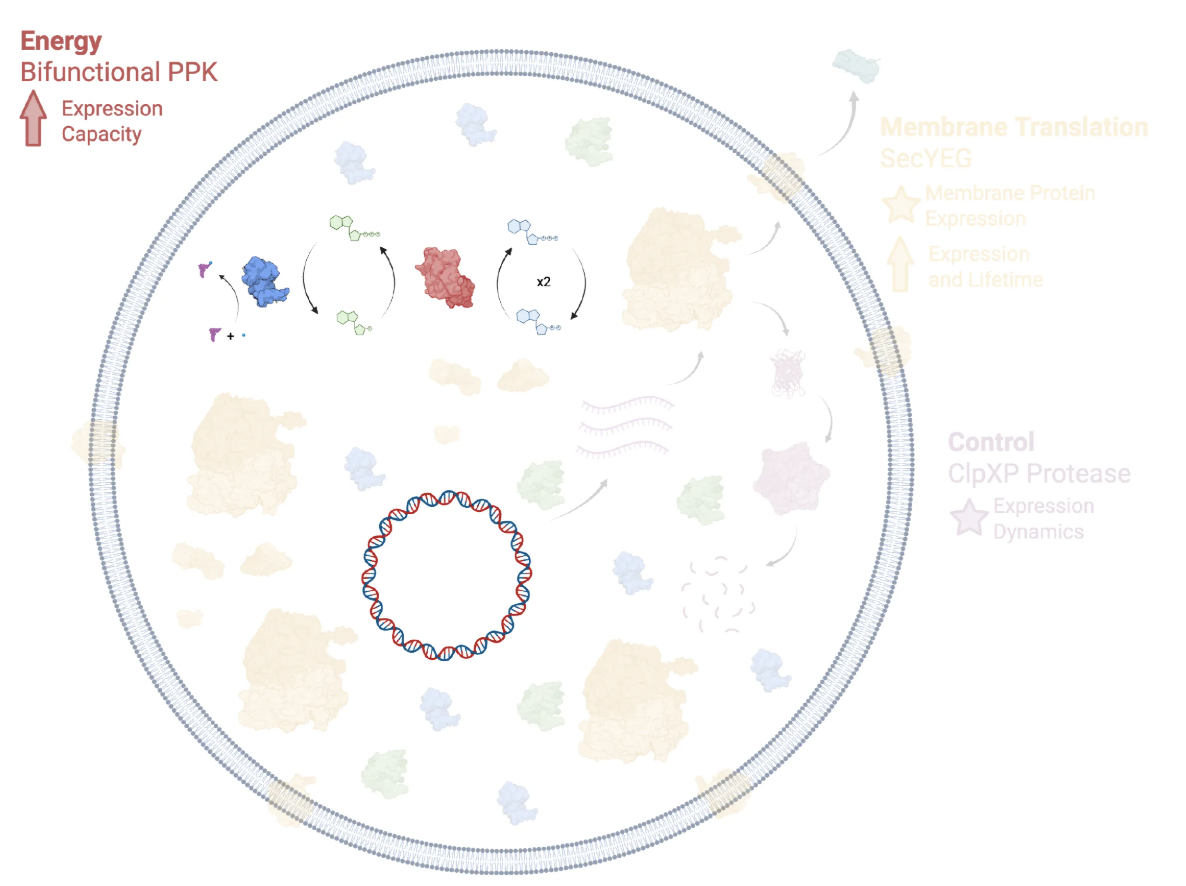
Where the PPK Energy module sits in the Developer Cell, raising expression capacity. The grayed-out components are separate modules — SecYEG membrane translation and ClpXP protease control.
The PPK Energy module consists of a purified protein, the bifunctional polyphosphate kinase (PPK2), and its substrate, the 100mer polyphosphate (PolyP). Here, bifunctionality refers to the module’s ability to direct the synthesis of ATP and GTP from AMP and GDP, respectively
When used alongside PURE’s standard energy regeneration module based on creatine kinase and creatine phosphate (CP/CK), significant increases in protein expression yields can result.
Reference Composition
The PPK energy module is implemented by preparing a custom energy mix and adding in purified PPK2 protein. The module is supplied as two components: purified PPK2 protein, and the 100mer polyphosphate substrate. No additional cell components are required.
| Construct | Size | Description | File |
|---|---|---|---|
pOpen-PPK-CHis | 2915 bp | Contains PPK2 in pOpen backbone. Does NOT have a promoter. | pOpen-PPK-CHis.gbk |
Custom SMix. The construction SMix without creatine phosphate (SMix -CP) is as follow. Note that normal SMix contains all of the following plus 20 mM CP.
| Component | Stock concentration (mM) | Concentration of components in reaction (mM) | Concentration in Energy solution (mM) | Final volume to add (µL) |
|---|---|---|---|---|
| HEPES | 1000 | 50 | 150 | 30.0 |
| Potassium glutamate | 2500 | 100 | 300 | 24.0 |
| Magnesium acetate | 1000 | 11.8 | 35.4 | 7.1 |
| rNTPs (each) | 100 | 2 | 6 | 12.0 |
| tRNA | 35 (mg/mL) | 3.5 (mg/mL) | 10.5 (mg/mL) | 60.0 |
| Creatine phosphate | 1000 | 0 | 0 | 0.0 |
| TCEP | 500 | 1 | 3 | 1.2 |
| Folinic acid | 5 | 0.02 | 0.06 | 2.4 |
| Spermidine | 200 | 2 | 6 | 6.0 |
| Amino acid solution | 3.25 | 0.3 | 0.9 | 55.4 |
| Water | 1.9 | |||
| Energy solution total | Final concentration (fold) | Final volume | ||
| 3 | 200 |
The following reaction table is a self-contained experiment for evaluating the performance of the PPK energy module. Details about the stock solutions and detailed reaction descriptions are available in the toggle list below.
Note: Concentration of Stock Solutions
| Component | Input concentration | Unit |
|---|---|---|
| Sol A | 2.50 | fold |
| Energy solution-CP | 3.00 | fold |
| Sol B | 3.33 | fold |
| plamGFP DNA | 120 | ng/µL |
| Mg-Acetate | 200 | mM |
| Creatine phosphate | 1000 | mM |
| PEG4K 40% | 40 | % |
| PolyP | 500 | mM |
| PPK2 | 57.5 | µM |
Note: Description of Reactions
| Name in Reaction Table | Description |
|---|---|
| CP/CK | PURE with CP and 8 mM Mg²⁺ |
| PPK/PolyP | PURE with PolyP, PPK and 18 mM Mg²⁺ |
| CP/CK + PPK/PolyP | PURE with CP, PolyP, PPK and 18 mM Mg²⁺ |
| + DNA Positive Control | PURExpress Positive control (PC) reaction |
| - DNA Negative Control | PURExpress Negative control (NC) reaction (without DNA template) |
| Component | CP/CK (µL) | PPK/PolyP (µL) | CP/CK + PPK/PolyP (µL) | + DNA Positive Control (µL) | -DNA Negative Control (µL) |
|---|---|---|---|---|---|
| Sol A | 14.00 | 14.00 | |||
| Energy solution-CP | 11.67 | 11.67 | 11.67 | ||
| Sol B | 10.51 | 10.51 | 10.51 | 10.51 | 10.51 |
| plamGFP DNA | 1.67 | 1.67 | 1.67 | 1.67 | 0.00 |
| Mg-Acetate | 1.40 | 3.15 | 3.15 | 0.00 | 0.00 |
| Creatine phosphate | 0.70 | 0.00 | 0.70 | 0.00 | 0.00 |
| PEG4K 40% | 1.75 | 1.75 | 1.75 | 0.00 | 0.00 |
| PolyP | 0.00 | 2.10 | 2.10 | 0.00 | 0.00 |
| PPK2 | 0.00 | 1.22 | 1.22 | 0.00 | 0.00 |
| Water | 7.30 | 2.93 | 2.23 | 8.82 | 10.49 |
Expected Behavior
Cytosols
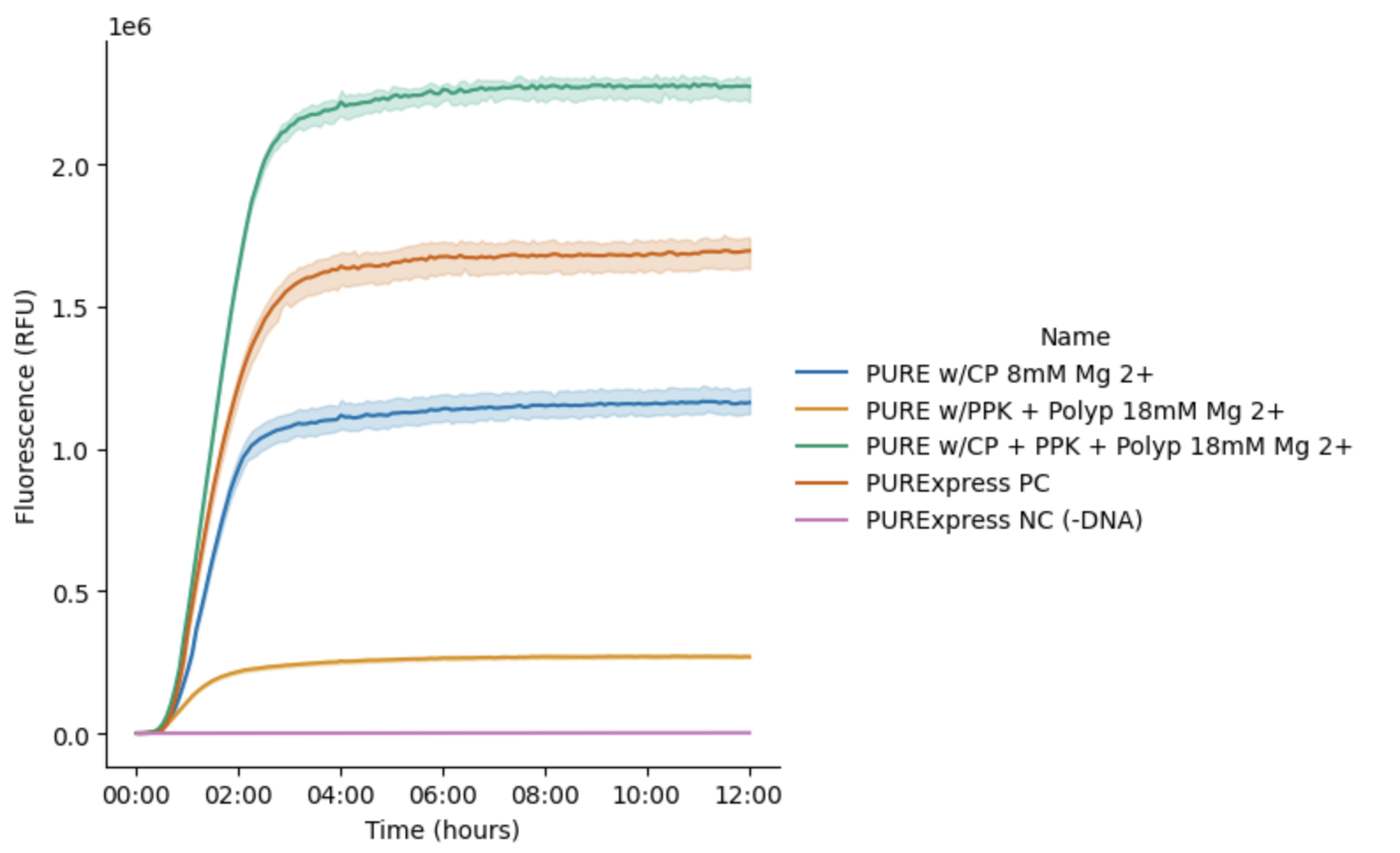
Translation kinetics of PURE reactions using different energy modules. The PPK2 module performed approximately 77% lower than the CP/CK module. However, the combination of PPK2 and CP/CK modules resulted in approximately 96% higher final protein yield than the CP/CK module alone.
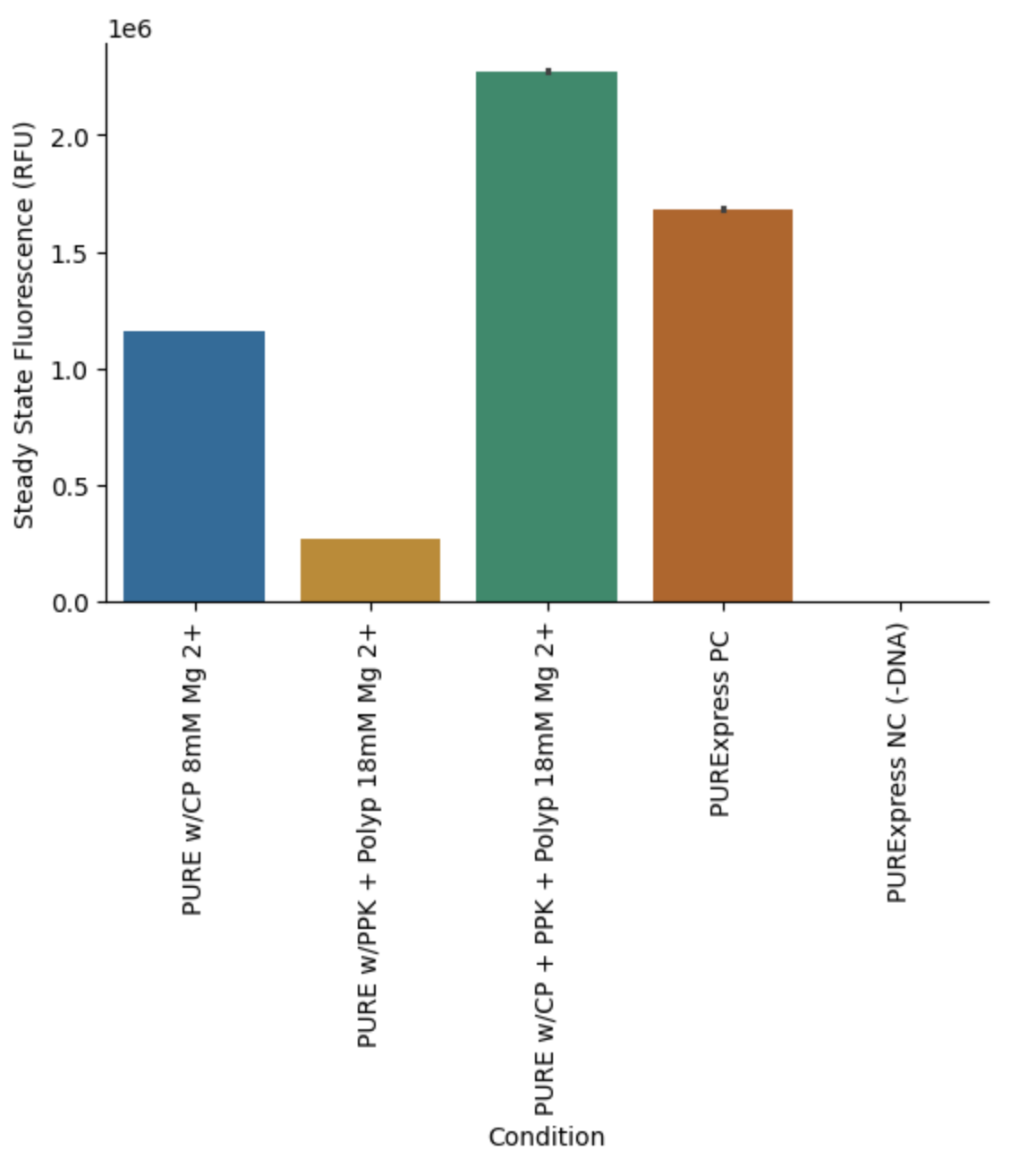
Final protein yields of the reactions measured at steady state. The PPK2 module performed approximately 77% lower than the CP/CK module. However, the combination of PPK2 and CP/CK modules resulted in approximately 96% higher final protein yield than the CP/CK module alone.
![The PPK energy module is highly sensitive to [Mg²⁺]. Final protein yields of PPK2-powered PURE reactions at different Mg²⁺ concentrations. PPK2 enzyme and polyP were added at a final concentration of 2 µM and 30 mM, respectively.](/build/mg-sensitivity-c52363c953c6decd8aee7e3fcf8e0945.png)
The PPK energy module is highly sensitive to [Mg²⁺]. Final protein yields of PPK2-powered PURE reactions at different Mg²⁺ concentrations. PPK2 enzyme and polyP were added at a final concentration of 2 µM and 30 mM, respectively.
Cells
Requirements
Requires pT7 transcription and translation (e.g. Base Cytosol). Requires an additional 10 mM Mg²⁺ (see below).
Highly sensitive to Mg²⁺. PolyP acts as a magnesium chelator, so this module is highly sensitive to the amount of Mg²⁺ in the Cytosol. The reactions above raise optimal Mg²⁺ from 8 mM to 18 mM; see the Mg Sensitivity figure for the dose-response.
Credits
Developed by Surendra Yadav (b.next).
- Hsu, Y.-Y. (2025). Integrating PPK Module in PURE Cells. 10.63765/mwur3749
- Yadav, S. (2025). PPK Module testing in PURE: PPK Module increases protein expression. 10.63765/djnv7772